
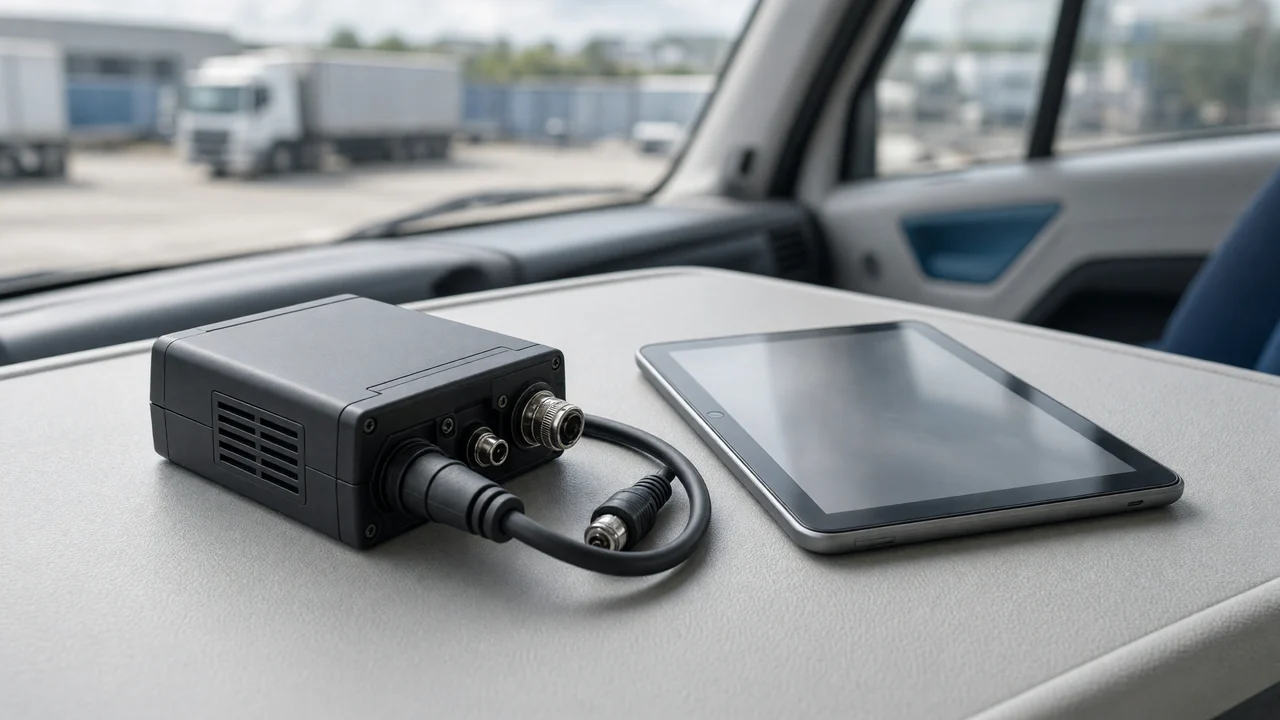
System architecture
A typical implementation combines a vehicle interface, device firmware, a driver application and a backend. The exact distribution varies. What matters is that the complete configuration meets the applicable requirements, including when a connection is interrupted.
| Layer | Questions to resolve |
|---|---|
| Device & firmware | Which engine signals are available? How are events timed, buffered and delivered? How are firmware updates identified? |
| Driver application | How does the driver identify themselves, review records, select permitted statuses and complete inspection workflows? |
| Backend | How are records retained, access controlled, corrections reviewed and output produced? |
| Operations | Who investigates malfunctions, supports drivers, validates releases and responds to regulatory changes? |
Start with 49 CFR Part 395, Appendix A and FMCSA’s provider resources. This architecture is explanatory, not a mandated implementation layout.
Records and event history
Map every required event and field to the technical specification. Identify the authoritative source for vehicle motion, distance, engine hours, time, location, driver identity and vehicle identity. Preserve enough provenance to explain how an event entered the system.
- Separate original events from subsequent corrections and annotations; do not make a mutable dashboard row the only record.
- Model the event types, statuses and sequence/check values required by the ELD specification.
- Support unidentified driving, driver assignment and team-driver workflows according to the rules.
- Keep driver review, proposed changes, acceptance/rejection and certification tied to the exact records involved.
Not every field is freely editable. Build a requirements matrix for who can propose or make each change, which original information must remain and which driver decisions are required. Avoid a generic “edit anything” administrator control.
Consult Appendix A’s event-recording and edit provisions and 49 CFR §395.30 on submissions, edits and annotations before implementing a rule.
Driver workflows
Write scenarios that begin with a driver’s situation and end with the required result: signing in, switching vehicles, reviewing unidentified activity, working with a co-driver, certifying a day or showing records at an inspection.
Hours-of-service calculations and ELD technical recording are related but different responsibilities. Automated HOS-violation warnings and full fleet-management features are not minimum ELD functional requirements. Determine which operating rules and exceptions apply before building a clock or violation indicator. Do not assume one carrier rule set covers every operation.
- Explain what the system recorded and what the driver needs to do.
- Keep UI wording aligned with the backend decision and the actual device state.
- Distinguish loss of a tablet connection from missing vehicle data, a diagnostic event or a reportable malfunction.
- Provide a deliberate workflow for disconnected operation, recovery and unresolved records.
Use 49 CFR Part 395 and the FMCSA ELD FAQs for the applicable requirements. A user interface is not a substitute for the required behavior.
Inspection and data transfer
Record display and transfer should be designed alongside capture—not added after the app appears finished. Implement the output fields, file structure, authentication and supported transfer method required for the registered configuration.
Use FMCSA’s current tools to check output and supported submissions. A successful format check alone does not prove correct event capture, accurate records or a compliant complete product.
- Test display/print or other required inspection presentation for the chosen configuration.
- Exercise the supported transfer mechanism with representative records, including edits and unusual event histories.
- Verify that provider, ELD and driver identifiers in output belong to the correct configuration and organization.
- Test failure handling without reporting a transfer as successful when it did not complete.
The FMCSA provider portal links to current technical and testing materials. Read the Appendix A output and transfer specifications directly.
Reliability and maintenance
Version the device firmware, mobile application, backend and operating-system combinations you support. Keep a traceable record of requirements, test results, defects and release decisions. Revisit qualification when a change affects relevant behavior.
Plan authenticated tenant access, per-resource permissions, transport protection, backups, restore tests and documented retention. Test duplicate delivery, retries, out-of-order events, timezone boundaries, phone restarts and interrupted updates.
Ask who owns the code, what licenses apply, who can maintain it, which integrations are included and who is responsible for testing and registration. Buying development, buying a device and licensing hosted software are different transactions.
This guide does not supply a complete design or certify a codebase. Work from the current specification and verify every applicable requirement against the actual system.
Educational guidance only. Requirements depend on the complete product, its configuration and use. Consult current official sources and qualified specialists.
Read the disclosures