
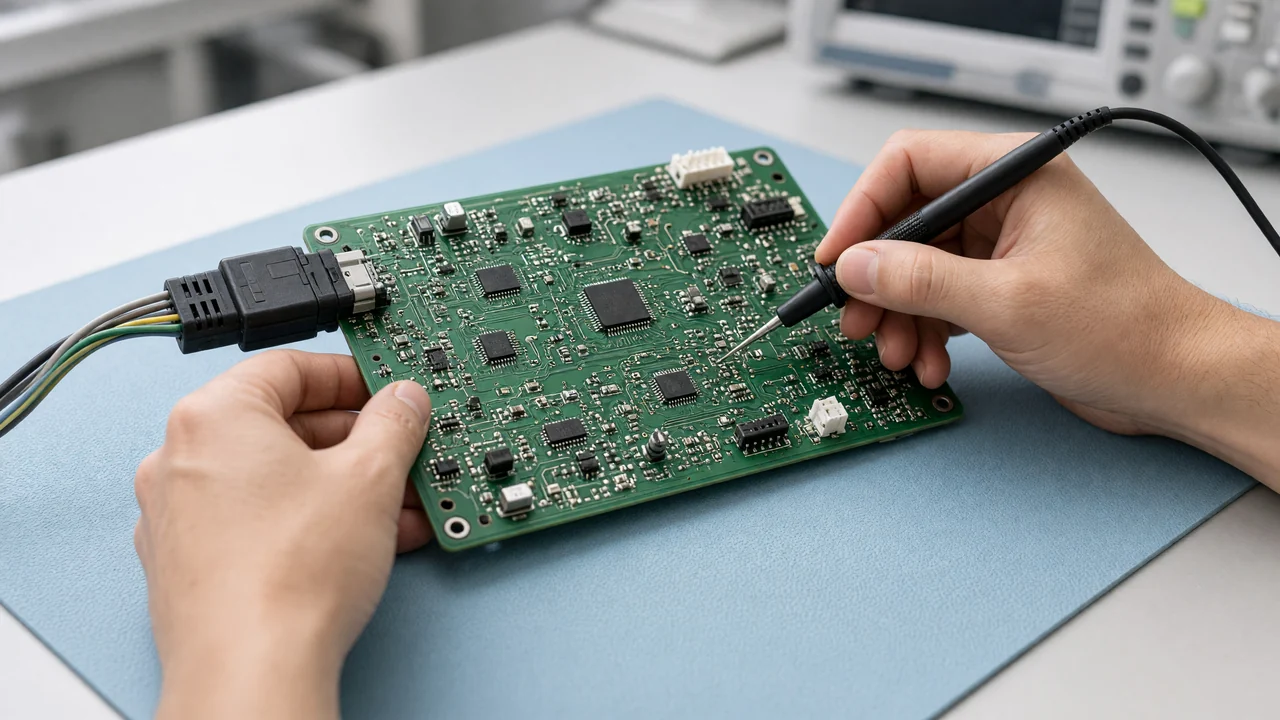
Vehicle interfaces
Define your supported engines, vehicle networks, connectors and power environment before choosing a board. A connector that physically fits does not establish that all required engine data is available or correctly decoded.
- Identify supported protocols, including J1939, J1708 or OBD-II where applicable, and the required cable or adapter.
- Verify engine-state, motion, distance and engine-hour data against the ELD specification and actual vehicles.
- Plan position and time sources, engine synchronization, event buffering and behavior when inputs are unavailable.
- Document the link to the phone/tablet or other driver interface, whether wired or wireless.
Validate what happens during starting, shutdown, power loss, reconnects and vehicle changes. A successful demonstration on one truck is useful evidence for that configuration; it is not universal compatibility.
See FMCSA’s technical resources and its guidance on smartphone-based ELD configurations.
Certified radio components are a starting point.
For a design with Bluetooth, Wi-Fi or cellular transmission, evaluate appropriately FCC-certified transmitter modules and their integration instructions. This can simplify the authorization path. It does not mean every finished product automatically inherits unrestricted approval.
- Confirm the module’s FCC ID, grant and permitted antenna configuration.
- Follow installation, labeling and use conditions associated with the authorization.
- Evaluate RF exposure and simultaneous-transmitter conditions in the final host.
- Ask a qualified laboratory or certification specialist whether the integration needs further testing, authorization or changes to the existing grant.
FCC obligations depend on the equipment and use. “No cellular” does not mean “no radio” or “no FCC obligations.” Conversely, not every electronic component needs its own FCC certification. Device-specific exemptions, including the transportation-device provision for certain digital devices, require assessment rather than assumption.
FCC equipment authorization addresses applicable radio-frequency requirements. FMCSA ELD requirements address the logging system. Evidence for one does not establish compliance with the other.
Primary references: 47 CFR §15.212, modular transmitters; §15.103, exempted digital devices; FCC 25-71, paragraph 14, module/host distinction.
Test the environment, not just the happy path.
Plan hardware validation around the intended installation and service life. Engineering validation is broader than an FCC test report. The following are practical scoping topics; they are not a claim that one named test standard is legally required for every ELD.
- Electrical: supply range, starting transients, power interruption, reverse-polarity protection and vehicle-bus behavior.
- Mechanical/environmental: connectors, cable strain, vibration, temperature, mounting and enclosure exposure.
- Wireless: supported antennas, RF conditions, pairing, coexistence and reconnects.
- Firmware: identified releases, interrupted updates, event buffering, memory limits and recovery.
- Complete system: device/app/backend behavior when hardware faults or communication failures occur.
Define acceptance criteria with specialists, keep traceable results and repeat affected checks when the board, antenna, firmware, enclosure or installation changes. Ask suppliers which evidence applies to the exact configuration you will ship.
Budget from a test plan—not a single number.
Test scope changes with radios, antennas, markets, available module approvals, host integration, prototypes and failed-test redesigns. Obtain an itemized quote before committing to a custom-component program.
This is an assumed budget scenario, not a published FCC fee, typical market price or maximum. Actual costs may be lower or higher. Do not treat it as an all-inclusive project estimate.
Have the laboratory and engineering partner separate the following items:
- Pre-compliance work and formal laboratory tests.
- Certification-body, filing and documentation work where applicable.
- Engineering design, prototypes and test fixtures.
- Redesigns, replacement samples and repeat testing.
- Additional markets, carrier approvals or other product requirements.
No allocation among those categories is assumed in the $40,000 example. A project quote must identify what is included, what is excluded and what triggers additional work. Software development and FMCSA complete-system validation need their own scope.
Buying a device can reduce the build scope.
An existing vehicle interface may save custom-board and radio-design work. Confirm which certifications, integration documents, firmware support and SDK rights come with the purchase. Do not assume buying the hardware includes a complete ELD application or transfers the supplier’s intellectual property.
Pacific Track, IOSiX and Geometris publish hardware or developer integration resources worth examining. If you want to develop fewer layers in-house, evaluate a combined hardware-and-hosted-software offering instead. Both routes require diligence on the final configuration and commercial terms.
Compare hardware suppliers and platform approaches ↗Educational guidance only. Requirements depend on the complete product, its configuration and use. Consult current official sources and qualified specialists.
Read the disclosures